React Native vs Native App Development: Which Is Right for Your Business?

A crucial step you’ll encounter as you build a mobile app is deciding which framework will best serve you. This step is considered important as it has an impact on your application’s performance, long-term maintenance, development schedule, and budget.
React Native app development is generally the right approach for business apps since it allows for one codebase and cuts costs by approximately 35%. The performance level of React Native applications is also much higher and is almost equal to native applications now. As a native app development approach, it’s best kept as a last option and is mostly implemented in cases when you need to work for a non-targeting platform (another OS for the project), or you need to involve significant hardware components (like virtual reality, augmented reality and even 3D scanners using LiDAR).
This guide compares React Native and native app development to help you determine which approach best suits your business goals.
React Native vs Native App Development: Quick Comparison
| Factor | React Native | Native Apps |
| Developer | Meta | Apple/Google |
| Language | JavaScript | Swift/Kotlin |
| Platforms | iOS & Android | Platform-specific |
| Performance | Excellent | Maximum |
| Cost | Lower | Higher |
| UI Control | High | Complete |
| Best Use | Business apps | Hardware-integrated apps |
Why React Native Fits Most Business Apps
One Codebase, Two Platforms
When you build your app with React Native, 80% or 95% of your code can be shared between your Android and iOS apps, which ensures that iOS and Android apps can both be developed at the same time and by the same team.
Faster Time to Market
React Native enables faster development with a smaller team, making it ideal for launching an MVP quickly on both Android and iOS. So, the product will get to market sooner and get early feedback from your users and validate the idea before investing too much capital.
Lower Development Cost
Reusing the code across different platforms usually cuts development expenses. React Native app development is about 30–35% cheaper than native app development. Case studies indicate React Native can save about 43% of the time it takes to develop an app. An example study indicated it took about 37 days to build the same app in React Native as it did in native Swift, restricted to iOS alone.
Performance That Meets Business Needs
A well-optimised React Native app can provide almost the same user experience as a native application for most list-, forms-, dashboard-, and common business interaction app users. In fact, a performance test of the Discord app revealed a 2-second reduction in their first load time with a maintained 60 FPS performance on all devices.
Who Should Choose React Native?
React Native is an excellent choice for apps that have standard user interfaces and common business workflows. It works especially well for:
- News and content platforms
- eCommerce apps
- Social networking apps
- Customer portals
- Utility apps that mainly display information, manage user accounts, or support everyday interactions
It is also a strong fit for internal business apps such as the following:
- Employee portals
- Operational dashboards
- Field service apps
- Data entry tools
These types of apps usually need to run smoothly on both iOS and Android, but they do not require highly specialised native features or heavy graphics processing.
Estimated Cost Comparison (AUD)
| Development Approach | Average Cost Range (AUD) |
| React Native App Development | $50,000 – $150,000+ |
| Native App Development | $100,000 – $300,000+ |
Figures are indicative only and vary depending on functionality, integrations, design complexity, and infrastructure requirements.
When Native Is the Better Call
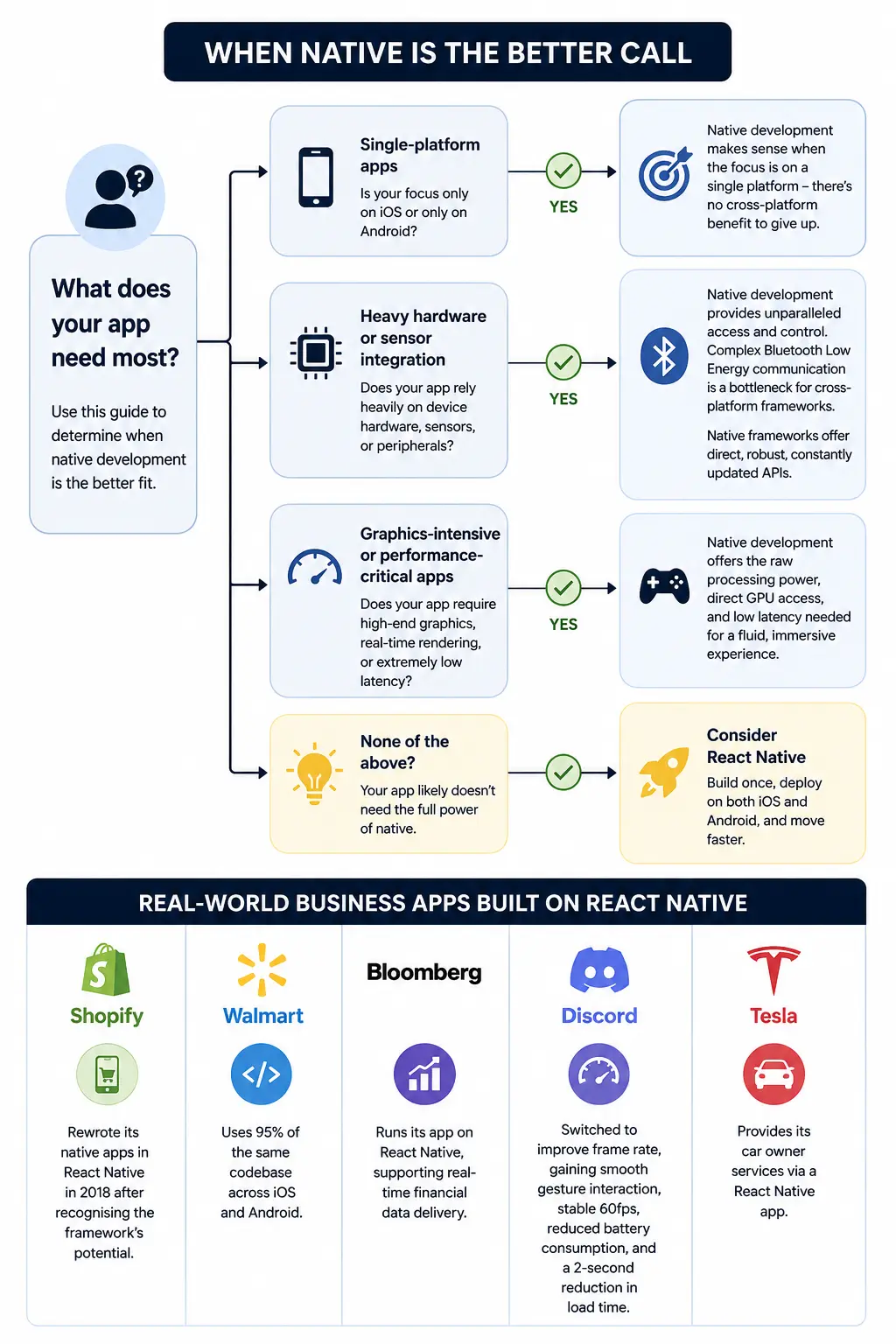
Single-platform apps. Native development makes sense when the focus is on a single platform – there’s no cross-platform benefit to give up.
Heavy Hardware or Sensor Integration
Native apps give you the most access and control when your app depends on certain device capabilities such as advanced camera controls, accurate GPS navigation, complex sensor data, or custom peripheral connectivity. For cross-platform frameworks, for instance, complex Bluetooth Low Energy communication presents a serious problem. Native frameworks offer direct, strong, always up-to-date APIs, whereas cross-platform tools come with an abstraction layer that may cause bugs and delays when using new hardware capabilities.
Graphics-Intensive or Performance-Critical Apps
Apps that rely heavily on graphics and/or performance. If the game is complex and has 3D graphics, augmented reality or virtual reality applications, native development will provide the processing power, direct GPU access and low latency that fits the needs for a fluid and immersive gaming experience.
Real-World Business Apps Built on React Native
- Shopify – rewrote its native apps in React Native in 2018 after recognising the framework’s potential for the platform.
- Walmart – uses 95% of the same codebase across iOS and Android.
- Bloomberg – runs its app on React Native, supporting real-time financial data delivery.
- Discord – switched to improve frame rate, gaining smooth gesture interaction, a stable 60fps, reduced battery consumption, and a 2-second reduction in load time.
- Tesla – provides its car owner services via a React Native app.
The Bottom Line
For most business apps, including booking applications, customer portals, in-house software, e-commerce platforms, and service applications, you do not need to develop for VR devices or LiDAR sensors. What you need are apps that perform, ship fast and won’t break the bank. And React Native fits the bill!
If you’re planning to develop your business application and are looking for personalised advice, feel free to contact us, and our team will advise you on what solutions fit best for you!
Frequently Asked Questions
Is React Native good enough for a business app?
Yes, React Native provides end users with performance comparable to native for most business applications. It’s already running production apps for Shopify, Walmart, Bloomberg and Discord.
How much cheaper is React Native than native development?
React Native app development lowers development costs by 30–35% compared to native development, as a single codebase is utilised for both iOS and Android, which reduces the need for separate teams and duplicated effort.
When should I choose native over React Native?
React Native is the best option if your app needs deep hardware integration, such as AR, VR, 3D scanning with LiDAR, advanced sensors, or custom additional devices. You could also choose React Native if you are focusing only on a single platform.
Can React Native handle AI or machine learning features?
Yes. React Native supports AI integrations such as chatbots, recommendation engines, and search. If your project requires advanced AI capabilities, our AI software development team can recommend the right implementation approach.
Do any large companies use React Native?
Yes, some of the world’s leading companies such as Facebook, Pinterest, Skype, Uber, and Brex do use React Native.