MYER
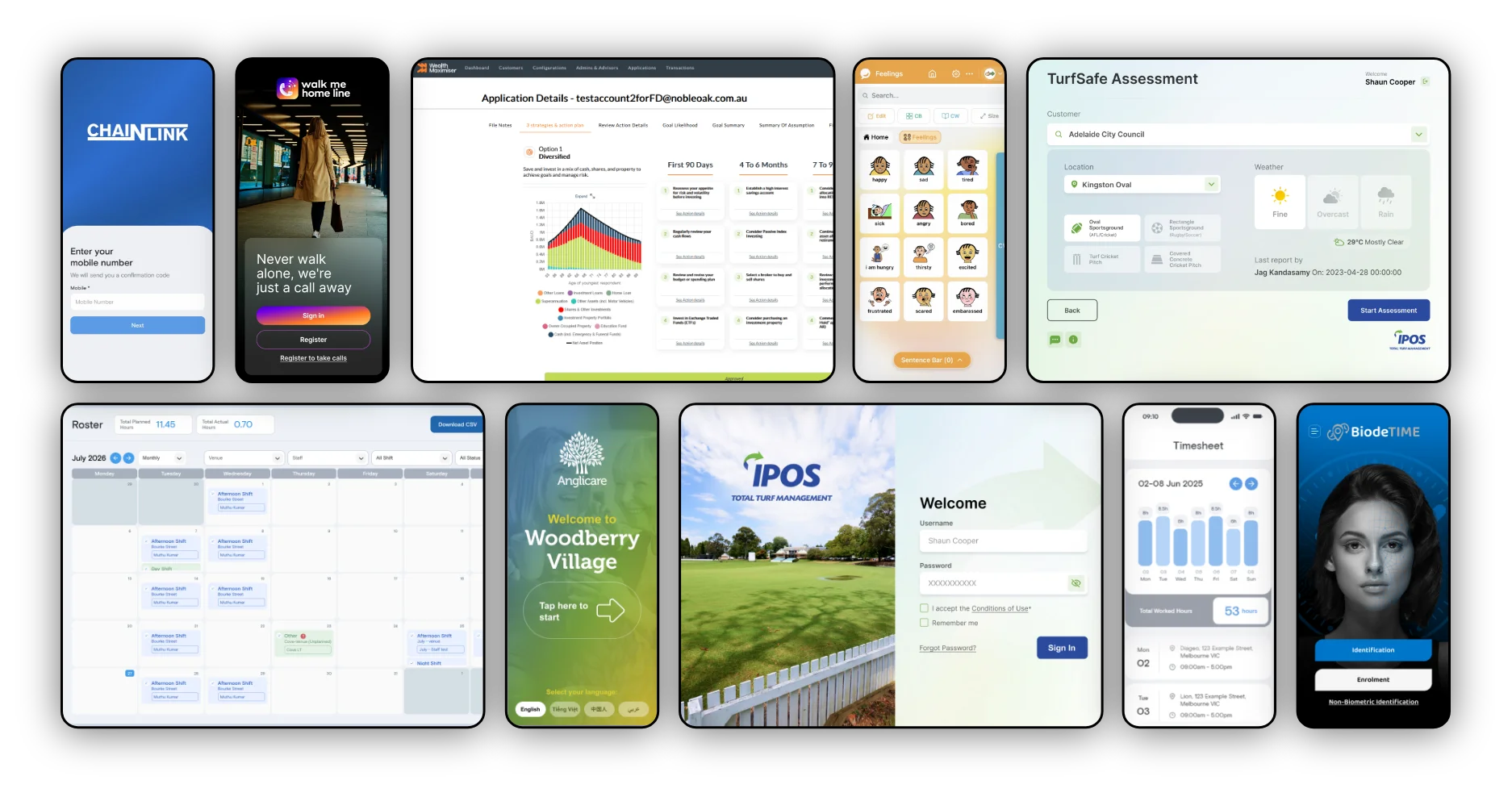
Developed and maintained scalable Warehouse Resource Management software.



MYER
Developed and maintained scalable Warehouse Resource Management software.

Anglicare
Mobile app with ARCHIBUS integration kiosk stand software development.

Visuals2Go
Cross-platform mobile & tablet app for disabled people.

NobleOak
A complex financial model with end-to-end and AI customised user journey.

SydneyWater
Custom software integration between SAP ERP and InEight (project controls software).

Hillsong
Mobile donations form with payment gateway integration.

Metro Finance
Designed and developed a web application to manage & streamline shifts.

Site360
SaaS platform – Geofenced visitor management & fully customisable workflow forms.

Acorn Rentals
Custom accident replacement vehicle system that automates the entire rental process.

TaxToday
Streamlining instant refunds with highly secure cloud native application.

Legacy software modernisation is the process of updating or replacing ageing applications so they are secure, supported, easier to maintain and able to connect with modern tools. Depending on the system, that can mean a version upgrade, a move to the cloud, restructuring the code, or a full rebuild.
As a legacy system modernisation company in Australia with 18+ years of experience and a Sydney-based team of 45+ specialists, we help startups, SMEs and enterprises across Australia choose the right path for each system, not the most expensive one. Our legacy software modernisation services cover everything from a one-off framework upgrade to a complete, staged transformation, with minimal downtime and no loss of data.
Modernise Your System TodayWe pride ourselves on the work we deliver and the outcomes we achieve for our clients everyday.

The Designpluz team has allowed us to accelerate the time to market for our platform, translating to money in the bank.
David Philips
Biode
I’ve recently worked with the Designpluz team to develop our site, they have taken a complex offline model and built this into our website.
Sara Gill
NobleOak
I was looking for a design team that could build me a new website and solidify our brand in the market. If I were building a critical website in future, this would be my go-to team.
David Gleig
Bedbug Wholesale
Thx for helping us with our website design and development for our new venture. You made it really easy for us to consider the options available and delivered a great website which presents our services and capability succinctly and professionally to our target clients.
Manish Goklaney
Verveo
The team went above and beyond to launch earlier than expected and handled every challenge with patience and care. They were always responsive, easy to communicate with, and proactive in finding solutions.
Florencia Nicogossian
Topaz Furniture
Working with a dedicated project manager who was our single point of contact made communication seamless and efficient, which allowed us to go live on time and on budget
Mark Camilleri
Bremick
CRC have had a great experience with Designpluz on the development and implementation of our new website. They were thorough in their work making sure our specifications were met with accessibility in mind, and they provided a wonderful contemporary look.
Gwen Rogers
Community Restorative Center
Designpluz is an amazing company to work with! Everyone in their team is lovely to work and collaborate with. They always action task efficiently to make beautiful end results.
Amarni Story
New Age Veneers
Working with Designpluz was a great experience to build our Strathfield Plaza Website. Response time was commendable and overall result was great. Thanks to Mia and the Team!!
Matthew Woo
Strathfield Plaza
An experienced team, a bunch of great people, and simply amazing work. Designpluz was very patient with us as we chopped and changed our project
George Khoury
Knomis
Transparency is key in any partnership, and Designpluz excels in this aspect. They're upfront about their processes, timelines, and costs, which instills trust and confidence in their services.
Trinh Bui
Newington Lane
Priya and Mia have assisted us with our website updates and have been so professional, listening to what we wanted and providing us with updates throughout the process. ...they are so skilled at what they do and excellent at communicating with us on our level!
Joanne Baldwin
KU Legal
Priya and the team were fantastic to work with. They took the time to understand our brief, and deliver amazing results with high attention to detail.
Tommy Lim
SF Capital
The team at Designpluz are fantastic - quick responses; excellent work and just so easy to deal with particularly for website support. They are my go to for any website work.
Anthony Gray
MEAUST
Their answers to questions and general communication was very good which made the whole process a little easier.
Rob Archibald
Emjay Products
They are approachable, responsive, and have consistently taken the time to understand our marketing needs, accommodating all our requests with professionalism and efficiency. Looking forward to continued growth with Designpluz.
Jocelyn Szot
Nover

Our commitment to quality and client success, by the numbers.

18+ Years
Delivering Digital Solutions for Australian Businesses

45+ Specialists
Software Engineers, Architects, Web Developers, UI/UX Designers & Analysts

110+ Reviews
Verified Google Reviews from Australian Clients

100%
Australian Owned
Sydney-Based Leadership & Governance

ISO 9001 & 27001
Certification Program Currently Underway

1,000+ Projects
Successfully Delivered Across Multiple Industries

50K+ Users Daily
Across Australia and New Zealand, on platforms We Design and Support

$40M+ Annually
Processed Through Mission-Critical Financial Platforms

We review your existing systems, code, infrastructure and business needs to uncover technical issues and plan the right updates. This helps you to build a more secure, reliable and efficient technology environment.

By addressing outdated dependencies, unsupported components and security weaknesses, we upgrade technologies and strengthen access controls and other relevant security measures.

WeWe modernise your outdated software to improve performance, scalability, maintainability and user experience by re-architecting, refactoring, or rebuilding it. This is done while preserving the essential business workflows.

We modernise APIs and connect legacy applications with current business systems, third-party platforms and cloud services to improve interoperability and data exchange.

We break down monolithic applications into smaller, independent services that are easier to develop, deploy and maintain. This approach gives your team more flexibility to update features without affecting the entire application.

Our team upgrades database platforms, optimises schemas, and migrates data to modern database technologies while maintaining data integrity and application compatibility.

We move legacy applications and workloads to suitable cloud environments by planning the infrastructure changes, dependencies, data integrity and deployment in order to minimise disruption.

We rebuild outdated parts of your software or replace the entire application when routine upgrades are no longer enough to meet your business needs.

We reshape existing code, remove unnecessary complexity and improve application architecture to make your systems easier to maintain, test and extend.

Not every system needs a rebuild. If the core of your application is sound, our software upgrade services move it to supported versions of its framework, database, libraries and hosting. This is usually the fastest, lowest-cost way to remove security risk and restore vendor support.
The Australian Signals Directorate (ASD) warns that legacy technology creates significant and ongoing cyber security risk, and that replacing it is the only long-term fix. Our legacy software modernisation services follow this guidance: we identify your legacy systems, reduce immediate risk with interim safeguards, then upgrade or replace them in safe, planned stages.
Typical upgrades include:
We use modern technologies to transform outdated software into high-performance solutions that align with today's digital standards. Our development expertise includes .NET, PHP, SQL Server, React Js, Node.js, React Native, Azure, and AWS, enabling us to build secure and scalable applications. We also apply MACH Architecture principles, using Microservices, API-first development and Headless systems to create modular, scalable, and future-ready solutions.

Our Sydney-based software developers create custom legacy modernisation plans aligned with your architecture, technology, and business goals. We help businesses overcome challenges like slow performance, data silos, security vulnerabilities, high maintenance costs, integration issues, and inefficient workflows.

We provide complete software modernisation services for Australian businesses through software audit, application migration, software re-architecture, and deployment. Our approach gradually replaces components while keeping core operations running, minimising disruption, and reducing costs.

We build to the ASD Essential Eight and Australian Privacy Principles, with hosting in Australian cloud regions available. We’re a registered NSW Government supplier, and our ISO 9001 and 27001 certification programme is under way.

After launch, we offer ongoing support, performance tuning, and identification of scaling options to keep your system reliable and adaptable.
Building future-proof bespoke software tailored to specific business needs requires the right tools and technologies.

Modernised applications eliminate bottlenecks and reduce downtime, boosting productivity with faster load times and consistent responsiveness across all devices and platforms.

Modernising legacy software helps reduce technical debt and maintenance costs by replacing or upgrading unstable components. This improves system reliability while freeing up IT budgets and resources, allowing organisations to focus on innovation and strategic growth.

Legacy systems are often associated with unpatched vulnerabilities and outdated compliance frameworks. Strengthening them improves your overall security posture and aligns your systems with modern compliance requirements.

Modernised software integrates seamlessly with APIs, CRMs, ERPs, and other business applications so that your systems work alongside newer technologies without friction.

With legacy system upgrades, you can access your real-time business data without any interruption, which leads to better decisions, operational intelligence, and performance monitoring. Advanced analytics, dashboards, and reporting features provide deeper insights to drive efficiency and growth.

Modern technologies enable greater flexibility to innovate and respond quickly to market changes. Upgrading legacy systems helps businesses stay competitive, adapt faster, and thrive in today’s fast-paced digital environment.
Step 1
We start with a complete audit of your current systems to identify technical debt, security gaps, performance constraints, and modernisation opportunities, giving us a clear baseline for the transformation ahead.
Step 2
Collaboration is key to our strategy. We work with you to establish clear objectives and create a custom roadmap for an effective legacy system upgrade aligned with your vision.
Step 3
We reengineer application logic, migrate legacy databases, and modernise system architecture using future-ready technologies, secure transformation practices, and a suite of code refactoring services.
Step 4
Our robust testing ensures the upgraded system functions as intended, integrates with new platforms, and achieves the necessary security and compliance requirements after our legacy system modernisation services.
Step 5
By integrating DevOps practices into our modernisation pipeline, we ensure faster deployments, continuous testing, and reliable rollouts across every stage of your software transformation.
Step 6
Our services don’t end once the systems go live. Ongoing support and performance monitoring ensure your modernised system continues to deliver value and business agility as your organisation evolves.

AI helps map large, undocumented codebases quickly, identifying dependencies, dead code and risk areas.
We generate clear documentation of business rules and logic hidden inside legacy code.
AI helps create regression tests faster, giving you a stronger safety net before changes are made.

Once your system is modern, you can add AI features such as chatbots, document processing and predictive analytics.
Common signs include rising maintenance costs, slow performance, failed security audits, out-of-support frameworks or databases, poor integration with modern tools, and reliance on one developer or spreadsheet workarounds. Two or more signs mean it’s time for an audit.
No. Our standard modernisation services include secure data migration processes that preserve all your existing data, ensuring integrity, confidentiality, and continuity throughout the transition.
Our software modernisation services improve performance, reduce long-term costs, and future-proof your systems, delivering measurable ROI and sustainable business value.
Yes. We reverse-engineer and document the system first, so business rules and logic are captured before any changes are made.
You do. You receive full ownership of the code and IP, along with documentation and knowledge transfer.
We modernise .NET Framework and older .NET versions, Microsoft Access databases, Excel-based processes, older PHP, AngularJS and jQuery frontends, older SQL Server versions and on-premise servers, moving them to .NET 10, modern frameworks and Azure, AWS or Google Cloud.
It depends on the condition of your code and your goals. If the system works well but is out of support, an upgrade is usually best. If it’s hard to maintain or can’t scale, refactoring or re-architecting makes sense. A rebuild is only recommended when the code is beyond economic repair.
Timelines vary depending on the project. For most legacy system modernisation projects, it takes 8 to 20 weeks, depending on the system size, complexity, and migration factors.
An upgrade moves your system to newer, supported versions of the same technology. Modernisation goes further, changing the architecture, platform or technology to improve scalability, integration and long-term maintainability.
It depends on your system’s condition and goals. Upgrade or rehost systems that work but are out of support; refactor or re-architect hard-to-maintain systems; rebuild only when code is beyond repair. Our audit recommends the best option.
We modernise software for retail, logistics, manufacturing, healthcare, large organisations, financial services, banking, education, construction, government, not-for-profit organisations and other type of industries. Our clients include MYER, Sydney Water, Xylem, Anglicare and NobleOak.
Unsupported software no longer receives security patches, so known vulnerabilities stay open. According to ASD, this makes cyber incidents more likely and more damaging, and can lead to systems going offline and disrupted services.


© Designpluz 2026
ABN: 75 603 015 041



We pay respect to the Traditional Custodians and First Peoples of Australia, and acknowledge their continued connection to their country and culture.