
How to Rank in Google AI Overviews?

Google Search visibility is no longer defined solely by organic rankings. With the introduction of AI Overviews, Google now generates AI-driven responses that appear at the top of the search engine results page, extracting and synthesising information from authoritative web sources.
This development has further fueled the growth of zero-click searches, where over 60% of searches are now answered directly from the results page. This means that being featured in AI Overviews has become a highly important visibility channel, often providing more visibility and user engagement than a #1 ranking.
Being featured in AI Overviews is an algorithmic evaluation of content, not purely dependent on ranking position. Google’s AI algorithms favour pages that have a clear information structure, high semantic relevance, and high factual accuracy. In this blog post, we will discuss how AI Overviews work and provide the essential optimisation strategies to increase the chances of being featured in 2026 and beyond.
What are AI Overviews?
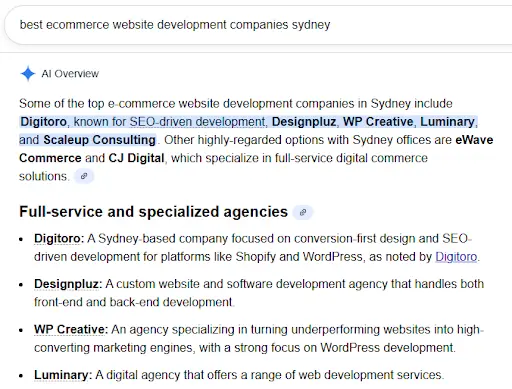
AI Overviews are summaries generated by AI that are displayed at the top of Google Search results for specific searches. Instead of the usual list of organic search results, Google shows a combined answer to the question being asked.
Rather than directing users to websites first, AI Overviews provide an immediate answer to the query. The supporting websites are referenced separately within the overview.
How AI Overviews Work
- Pulls information from multiple sources: Google doesn’t rely on just one website. Its AI scans through several trusted pages, compares the content, and then combines the best parts into one clear summary.
- Shows quick steps, tips, or definitions: AI Overviews are optimised for fast information delivery and often include short explanations, definitions, or step-by-step guidance for informational and how-to queries.
- Links to a few websites as “sources”: Below the AI-generated summary, Google displays a small set of source links used to generate the overview. These websites are effectively cited within the AI Overview, gaining increased visibility and perceived authority.
Why Are AI Overviews Important for SEO?
AI Overviews have revolutionised the way people interact with Google Search. In the past, users would browse through the links and select a website to visit. However, with the AI Overviews, Google Search displays an answer generated by the AI first, and this means that fewer people click further.
This is one of the main reasons why many websites experience sudden changes in traffic. Even if the ranking position is not affected, the AI Overviews may capture the attention of users before the organic results are seen.
A few reasons this matters
- AI Overviews appear above all organic results: They sit right at the top of the page, even before the first-ranking website. So naturally, they get the most visibility.
- They highlight only selected websites as “trusted sources”: Google doesn’t include every page. It chooses only a few that seem reliable, well-written, and useful. Getting featured here builds strong authority.
- They can change search behaviour: When people receive an instant answer, many users do not always scroll down and often stop there. This means fewer clicks on the traditional search results.
- Brands with clear content gain more visibility: Well-structured, accurate, and useful content can gain more exposure through AI Overviews than traditional rankings, even without being in the top organic positions.
That’s why SEO today is not just about ranking; it’s about being the content Google’s AI decides to show first.
How to Rank for AI Overviews?
Ranking in Google AI Overviews does not follow a fixed set of rules. Google has not published an official guide, and the system is still evolving. However, when you analyse the kind of pages that repeatedly appear inside AI Overviews, you can clearly see certain SEO patterns.
If you want your website to be featured, you need to make your content and site AI-friendly and boost your website’s visibility. Here are the most important ways to do that:
Create Content That Directly Answers Questions in Simple Language
Google’s AI values simplicity. When a page offers a clear and easily understandable answer at the top, it will rank higher in AI Overviews because the answer is readily available without having to scroll down.
When the language used is simple and to the point, without unnecessary introductions, Google’s AI can easily read and extract the answer.
Add Small Step-by-Step Sections or Quick Summaries
AI Overviews favour content that offers solutions in a structured manner. Google can immediately know which section of the page is the solution to the problem when your blog contains step-by-step instructions, brief summaries, or quick takeaways.
This means content should be structured not only for readers, but also for AI systems to interpret efficiently. The better the summary or process-based explanation is written, the easier it is for AI to reuse the information accurately.
Use Clear Subheadings So AI Can Understand the Structure
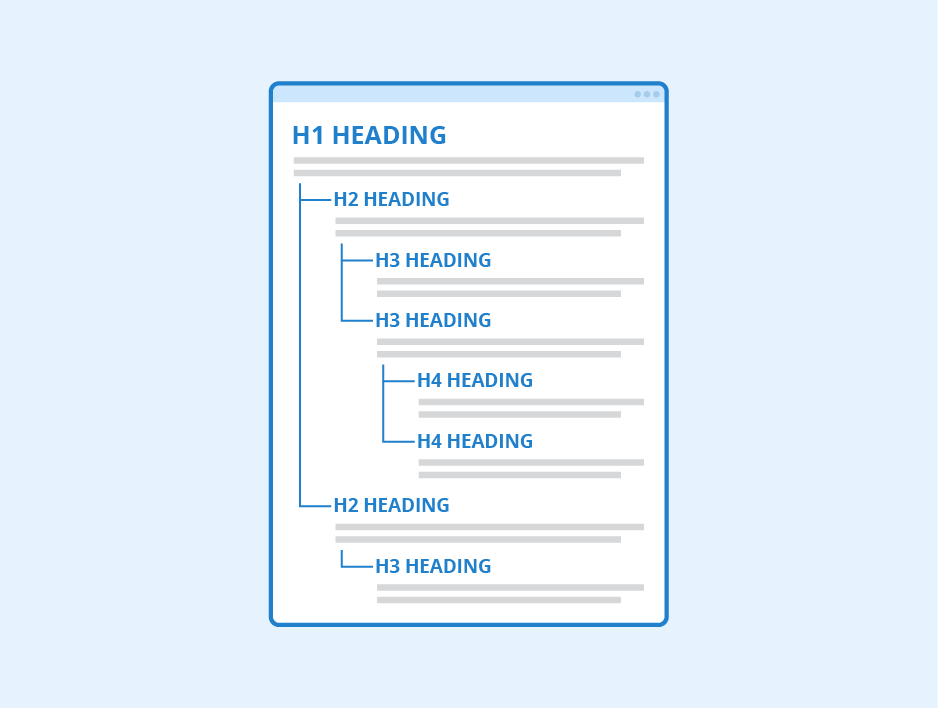
Content structure plays a critical role in AI Overview selection. Google’s AI depends heavily on headings to understand what your content is about and where specific answers are located. Blogs with clean H2 and H3 subheadings are much easier for AI systems to scan, interpret, and extract information from.
Instead of writing long blocks of text, break your content into meaningful sections. When each heading reflects a clear intent, your chances of being selected increase.
Focus on E-E-A-T: Experience, Expertise, Authority, Trust
AI Overviews don’t just pull information from anywhere. Google prioritises content that feels trustworthy and comes from sources with real credibility.
That’s where E-E-A-T plays a critical role:
- Experience indicates that the content is a reflection of real knowledge or involvement in the subject matter.
- Expertise suggests that the content is written by someone with a lot of knowledge about the subject matter.
- Authority is established when a source is recognised in its industry or niche.
- Trust suggests that the content is accurate, reliable, and safe for users.
Pages that offer authentic insights, expert support, and clear trust signals are far more likely to appear in AI-generated summaries.
Make Sure the Page Loads Fast and Avoids Messy Layouts
Even the best content may go unnoticed if the user experience is not good. If the pages take a long time to load, if the layout is cluttered, if there are pop-ups, or if the content is not readable on mobile devices, it will negatively impact the user experience and make Google less likely to rank the page.
AI Overviews are built to provide fast and frictionless answers, so Google favours pages that load quickly, have clean layouts, and provide a smooth user experience.
Include FAQ-Style Answers Within the Blog or Landing Page
The FAQ sections are very effective for AI Overviews as they provide answers to questions in a short, direct, and well-structured manner. This helps Google’s AI to easily identify and extract the relevant answers from the FAQs.
The FAQs are also helpful in addressing multiple related questions on a single page, which helps in better topical coverage with bite-sized answers that AI can confidently reuse.
Add Backlinks and Trust Signals
Authority still plays a major part. If reliable websites link to your content, it sends signals to Google that your site is established and trustworthy. This creates confidence not only for traditional rankings, but for AI Overviews as well.
Trust signals can include:
- High-quality backlinks
- Local business citations
- Reviews and profiles on websites such as Clutch and GoodFirms
- Mentions in niche publications
The stronger your online reputation, the more likely it is that Google’s AI will trust your site as an authoritative source.
Leverage Structured Data (Schema Markup)
Schema markup is one of the best ways to help Google understand your content clearly. It is a type of structured code that labels key elements on your page, such as:
- FAQs
- How-to steps
- Reviews
- Products
- Business information
When your content becomes machine-readable, Google’s AI finds it easier to interpret and extract it for Overviews. Even basic schema implementation can significantly increase your eligibility for AI-driven features, and a free schema generator tool makes it accessible even for non-technical users.
Common Mistakes That Stop Pages From Appearing in AI Overviews
Even if your website is ranking well in traditional search results, it may still not get featured in AI Overviews. That’s because Google’s AI has very specific expectations. It only selects content that feels clear, trustworthy, and genuinely useful.
Many pages miss this opportunity because of a few common mistakes:
- Not answering the main question directly: A lot of content spends too much time on introductions or background, but never gives a clear answer upfront. Google’s AI needs to quickly identify the exact part of the page that solves the user’s query. If the answer is buried or unclear, your page gets ignored.
- Writing generic or copied content: AI Overviews prioritise originality. If your blog sounds like every other article online or repeats the same points without adding value, Google sees no reason to feature it. Pages that show real insight and unique expertise are far more likely to appear.
- Using outdated information or old statistics: Google looks for the most relevant and up-to-date information. If your content has old information, outdated trends, or old statistics, the AI will choose newer sources over yours. Up-to-date information is a sign of reliability.
- Missing trust signals: If your website has poor backlinks, lacks online reviews, and has poor business information, Google may not find your website trustworthy enough to use as a source. A website with strong trust signals will make the AI confident about using your content.
Final Thoughts
Google AI Overviews represent a significant change in the way search visibility is attained. Just being ranked is no longer sufficient. Content must now be organised, accurate, and truly useful, coupled with superior technical optimisation and trust factors that enable Google’s AI to confidently display it as an answer, not just a result.
If you want your website to rank well in AI-powered search engines, the foundation is important. Designpluz can help you design and develop a fast-loading, well-structured, and scalable website that is SEO-friendly, user-friendly, and AI-friendly from the foundation level.